

The Silent Mirror
The Silent Mirror
Rakesur Rahaman
Size: 13.5 x 9.5 inches
Medium: Tempera on board
Couldn't load pickup availability
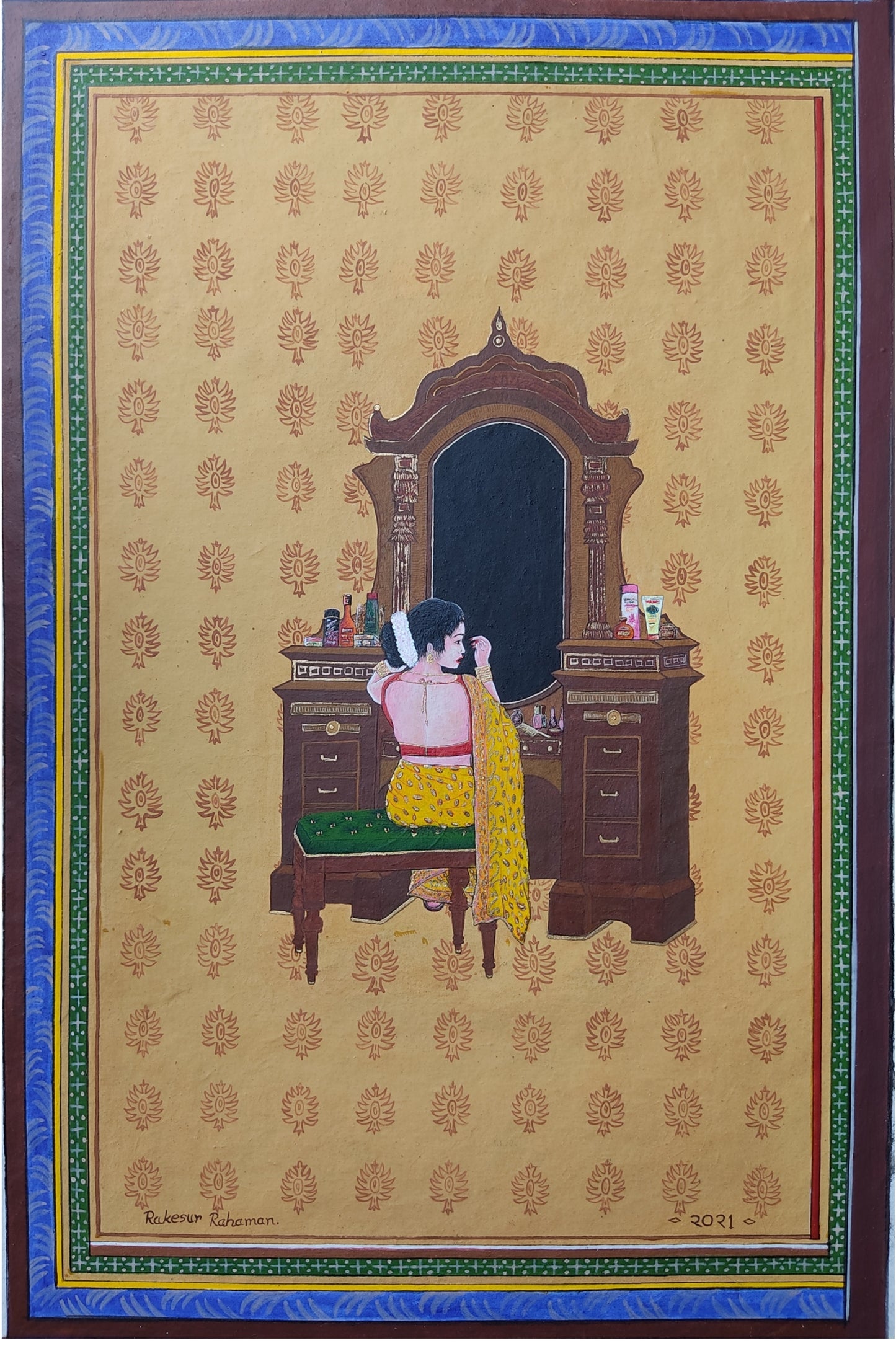
The Lady captures an intimate, timeless moment of self-reflection, where tradition and contemporary life quietly converge. At the heart of the composition, a woman sits before her ornate dressing table, absorbed in the simple yet profound act of adorning herself. Her sari, rich in yellow patterns, drapes with elegance, its folds echoing the delicacy of her gesture. The finely detailed wooden mirror—dark, silent, and unreflective—becomes less a literal object and more a metaphorical presence. It suggests the unseen dimensions of identity, the interior life that resists surface capture. The surrounding patterned background, recalling miniature traditions, transforms the domestic space into one of rhythm and harmony, where ornament itself becomes part of the narrative. What is beautifully arranged here is not only the balance of colors, textures, and forms, but the balance of eras: the traditional grace of the lady and her attire, juxtaposed with the unmistakably modern cosmetic bottles that line the table. Through this subtle interplay, the work reflects on continuity and change, on how beauty, care, and self-presentation remain eternal concerns, shaped differently in each age. The painting is at once a portrait of a single figure and a meditation on the evolving rituals of femininity, delicately poised between memory and modernity.
Artwork Specs
| Exact Size | 13.5 x 9.5 inches |
|---|---|
| Artist Name | Rakesur Rahaman |
| Medium | Tempera on board |
Meet the Artist - Rakesur Rahaman

Rakesur Rahaman’s practice grew from his early engagement with traditional miniature art during his training at the Government College of Art and Craft, Calcutta. His sketches of trees and landscapes evolved into works that blend fine brush drawing, decorative elements, and miniature motifs with contemporary concerns. Working mainly in tempera on rice paper, he mixes pigment and gum arabic by hand, using natural dyes and coffee stains to bridge historical methods with present-day expression.<... Read More